By the Rottweiler Dog Guide editorial team. This page is general education only — not veterinary advice and not a substitute for a qualified trainer who meets your dog.
Rottweiler puppy biting shows up in almost every new-owner inbox. Before you invent house rules, open the primary training pages, write what they actually say, and only then build a calm home checklist.
Primary pages to open first
Read those pages yourself. If this article and those pages ever disagree, follow the AKC pages and your trainer.
What those pages emphasize (in your notebook)
Write the ideas in their words, not ours:
- Mouthing and play biting are described as a normal part of puppy play.
- Bite inhibition means teaching a softer mouth over time — not “never use the mouth.”
- Ending play when teeth meet skin, then offering a chew toy, is a common pattern they discuss.
- Waving hands and sudden movements tend to invite more play biting.
- An overtired puppy can look like a “naughty” biter — check naps before you escalate.
Do not invent timelines, cure rates, or breed-specific aggression forecasts. Those belong in a consult, not a blog.
Home checklist after you open the pages
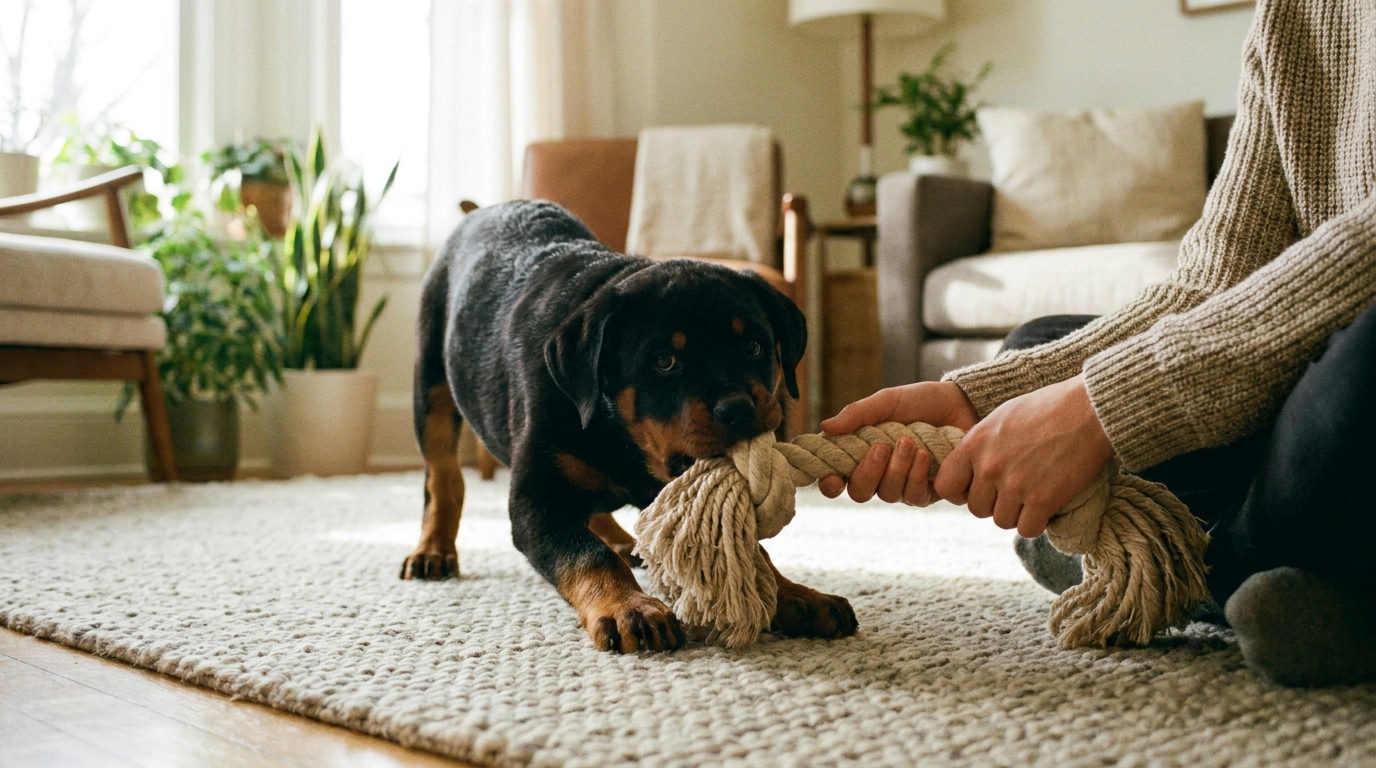
- Keep a chew or tug toy in every room where people sit.
- Offer the toy before bare hands when play starts.
- When teeth touch skin, pause play the way the AKC pages describe — then restart with the toy.
- If biting continues, calmly end the game and guide the puppy to a rest spot.
- Write one fridge note so every adult uses the same pause-and-redirect rule.
What stays off the list: shouting, tapping the nose, or holding the mouth closed. Rough handling is not part of this educational checklist.
Management that prevents practice
Management is not cheating. It simply stops the puppy from rehearsing habits you do not want.
- Quiet zone: crate or pen with a bed and chew for naps.
- Temptations tucked away: shoelaces, cables, dangling clothes.
- Busy-hour plan: a short sniff walk or food puzzle before the usual wild window.
Rules for children and visitors
- Play with a toy, never bare hands or feet.
- If teeth land, stand still and call an adult.
- No chase or wrestling games with the puppy.
- Leave the puppy alone when eating, chewing, or sleeping.
- An adult supervises every play session.
More calm-home ideas: balanced Rottweiler behavior.
Questions to ask your vet (write their answers)
- Do the teeth and gums look normal for this puppy’s age?
- Which chew types are safe for this puppy, and which to avoid?
- Is anything about eating or mouth comfort a concern?
This article does not name products, doses, or pain remedies.
When to bring in a professional
Call a qualified trainer or speak with your vet if you notice stiff body language with biting, guarding of food or resting places, fear when handled, biting that is getting harder instead of softer, or any situation where you feel unsafe. A puppy class can add hands-on coaching — ask your vet for local referrals.
FAQ
Does play biting mean my Rottweiler will be aggressive?
Not on its own. Open the AKC biting page and ask a trainer if anything on your worry list matches guarding or fear.
Should I yelp when my puppy bites?
Some puppies settle; others get more excited. The AKC mouthing tips note both outcomes. If yelping winds your puppy up, pause play instead.
How long will this phase last?
We will not invent a calendar. Keep a short diary of biting moments and review it with your trainer.
Is this professional advice?
No. It is a reading list plus a home checklist.
What not to do
- Do not invent “guaranteed soft mouth by week X” claims.
- Do not restated study percentages about breed risk.
- Do not skip the primary AKC pages and rely on social clips alone.
Why large-breed owners open the pages early
A Rottweiler puppy grows into a strong adult. Habits that feel small in the living room are harder to live with later. That is why this brand starts with primary training pages instead of viral clips. Write what the AKC pages say about ending play, offering a chew, and watching for overtired biting. Then teach every adult in the house the same pause rule.
Consistency beats intensity. One calm redirect, repeated, teaches faster than a loud reaction that confuses the puppy and frightens children.
A sample session log (no invented outcomes)
Keep a notebook line for each short session:
- Time of day and what happened just before (nap, guests, chase game).
- Whether a toy was already in your hand.
- Whether you paused when teeth met skin.
- Whether the puppy took the toy after the pause.
- Whether you ended the game and used the rest spot.
Review the log with your trainer. Do not invent a success percentage from the log — it is a memory aid, not a clinical score.
Energy outlets that are not wrestling
Many bitey evenings follow long indoor boredom. Safe outlets include a short sniff walk on leash, a food puzzle, or a calm tug with a long toy so hands stay far from teeth. Match the outlet to what your vet and trainer recommend for your puppy’s age and joints. This article does not prescribe exercise minutes.
Teaching guests before they walk in
Put the fridge note by the door. Guests who lean in with bare hands often restart the mouthing game. Ask them to greet with a toy on the floor first, or to ignore the puppy until it sits calmly. Your job is to protect the training plan, not to entertain every visitor with a wrestling match.
Crate and pen as rest, not punishment
Use the rest spot for naps and cool-downs. Pair it with a chew and a calm voice. If the puppy only sees the pen after a scolding, it may learn to fear the space. Educational training treats rest as part of the day, not as a penalty box.
Body language worth writing down
Stiff posture, hard stares, freeze-then-lunge, or guarding of food and beds are not “cute mouthing.” Write what you saw and show the notes to a professional. Do not diagnose aggression from a blog. Do not wait until someone is hurt before you ask for help.
Working with a trainer without shame
Asking for help early is responsible ownership. Bring your session log, your list of toys, and the AKC pages you already opened. A good trainer will watch the dog in front of them and adjust the plan. Online tips never replace that visit.
Related reading on this site
For calmer household habits, see balanced Rottweiler behavior. Keep veterinary questions with your clinic, and keep behavior questions with a qualified trainer when the checklist is not enough.
A weekly review ritual
Once a week, sit with the other adults in the house and read the fridge note out loud. Ask whether anyone broke the bare-hands rule. Ask whether the toy stock still covers every room. Ask whether the rest spot still feels calm. Small reviews keep the plan alive.
If a child is scared of the puppy’s teeth, pause free play and rebuild with a trainer’s guidance. Fear in the household is a reason to get help, not a reason to “push through.”
If you adopted an older puppy, still open the same AKC pages. Age does not remove the need for clear pause rules; it only changes how quickly you should book professional eyes-on help when biting feels hard.
Keep spare toys washed and rotated so the “right” chew stays interesting. A boring toy on the floor loses to a moving hand every time.
Closing tip
This week, open both AKC links above, write five bullet notes in their language, then run one pause-and-redirect session with a toy already in your hand before play starts.