By the Rottweiler Dog Guide editorial team.
Disclaimer: This article is for general educational purposes only and is not a substitute for professional veterinary advice, diagnosis or treatment. Always consult your veterinarian about your own dog, especially for puppies, seniors and dogs with health conditions.
Rottweiler cold weather care is worth planning before the first hard frost. Shorter days, icy paths, road salt and heaters all change your dog’s routine. This page is a reading list plus a winter-ready checklist. Open the primary pages first, write down what they say, and then prepare your home, your walks and your dog’s kit.
Primary pages to open first
Read those pages yourself. If this article and those pages ever disagree, follow the source pages and your veterinarian.
What those pages emphasize (write it in your notebook)
Write the ideas in their words, not ours:
- The AVMA cold weather page notes that each pet’s cold tolerance varies with its coat, body fat, activity level and health.
- It encourages owners to shorten walks in very cold weather and to watch for signs of discomfort.
- It mentions checking paws and keeping pets away from chemicals such as antifreeze and de-icers.
- The AKC breed page describes the Rottweiler’s coat, including an undercoat on the neck and thighs, which is useful context when you plan.
Do not invent temperature cut-offs or “safe minutes outside” rules. Ask your vet what suits your dog.
What this guide covers, and what it does not
This guide covers winter walks, paw care, home setup, chemical storage, indoor enrichment and the signs that mean you should bring your dog in and call your vet. It does not set temperature limits, does not diagnose cold-related illness, and does not recommend medicines. If you are worried about your dog in the cold, call your vet.
Know your own dog’s tolerance
The AVMA page makes the point that cold tolerance differs between pets. A healthy young adult may cope differently from a puppy, an older dog or a dog with a health condition. Start a simple winter log:
- Note the weather and how long you walked.
- Write down how your dog behaved, such as pulling to go home, lifting paws or shivering.
- Look back after a couple of weeks to see your dog’s pattern.
- Bring the log to your vet and ask how it compares with what they would expect for your dog.
Winter walk checklist
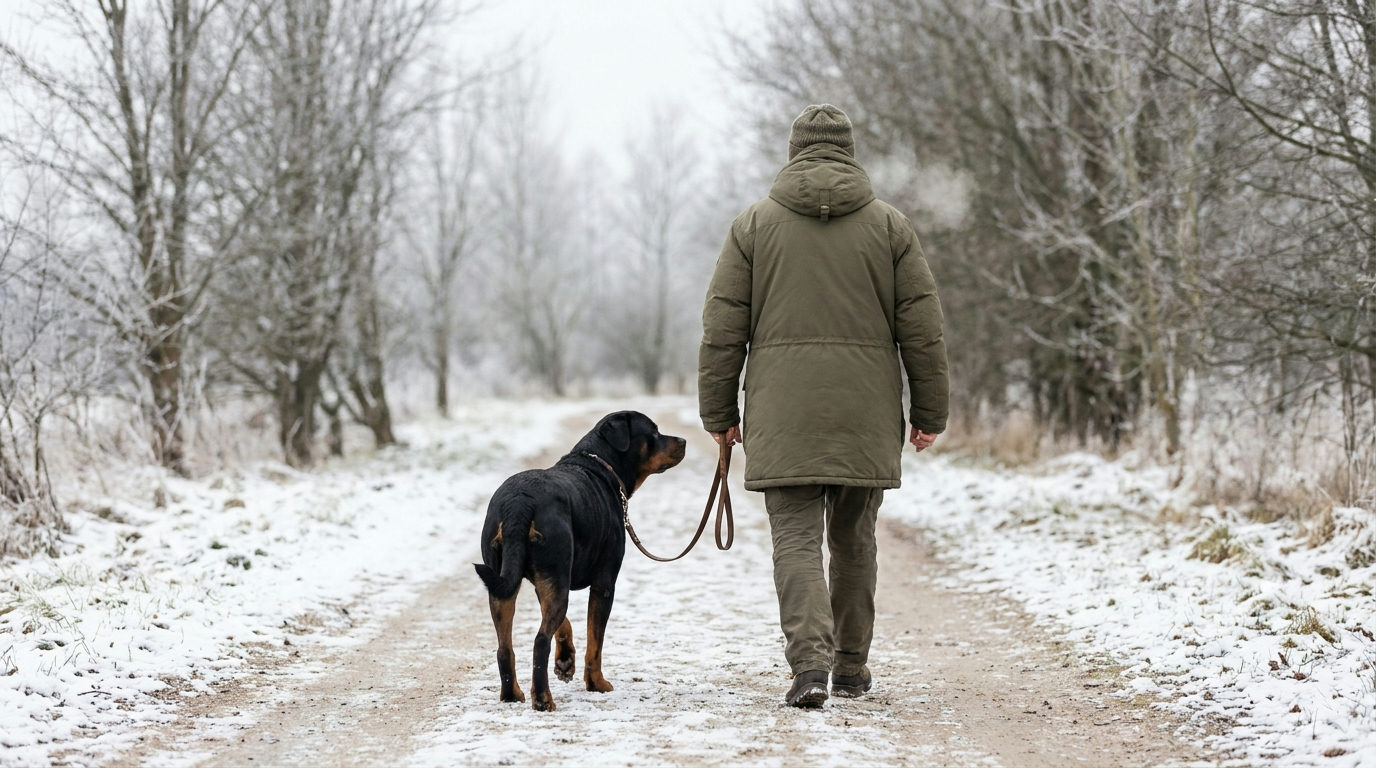
- Shorter, more frequent walks on very cold days
- Walks during the warmest, brightest part of the day where possible
- Reflective gear for you and a light or reflective collar for your dog
- A secure leash, since snow and ice can hide familiar landmarks
- Keeping away from frozen ponds and lakes
- A towel by the door for drying off afterwards
Watch your dog throughout the walk. If it starts lifting paws, shivering, slowing down or trying to turn home, head back.
Paw care
The AVMA page highlights paw checks in winter. Build these into your routine:
- Before the walk, check paws for cuts or cracks.
- After the walk, wipe paws, legs and belly with a damp cloth to remove salt, de-icer and grit.
- Dry between the toes.
- Look for redness, cracks or ice balls stuck between the pads.
- Ask your vet whether paw balm or dog boots suit your dog.
If you try boots, introduce them slowly at home with treats, one paw at a time.
Chemicals around the home
The AVMA page mentions antifreeze and de-icing products as winter hazards. Store them out of reach:
- Keep antifreeze and screen wash on a high shelf or in a closed cupboard.
- Wipe up any drips in the garage or driveway straight away.
- Ask whether pet-friendlier de-icers are available for your own paths.
- Keep your dog away from puddles near parked cars.
If you think your dog has licked or swallowed something harmful, call your vet or a poison control service straight away. Do not wait for signs.
Set up a warm, safe home
- A bed raised slightly off cold floors, away from drafts
- Extra blankets that are easy to wash
- Heaters and fireplaces guarded so your dog cannot get too close
- Fresh water that cannot freeze if your dog spends time outdoors
- A dry, sheltered place if your dog is in the garden for any length of time
The AVMA page encourages bringing pets indoors in cold weather. If your dog normally spends time outside, ask your vet what is suitable in winter.
Grooming in winter
Keep up regular brushing through the winter, since a clean, well-kept coat is easier to dry. Dry your dog thoroughly after wet walks and baths. If you are thinking about clipping the coat for any reason, talk to your vet or groomer first. Our essential Rottweiler grooming tips cover the rest of the routine.
Indoor enrichment for cold days
When walks are shorter, give your dog’s brain more to do indoors:
- Food puzzles and snuffle mats with part of the daily food
- Short training sessions to practise cues or learn new tricks
- “Find it” games, hiding treats around one room
- Calm tug games with a long toy
- Gentle grooming and massage sessions
Our guide to enrichment activities for dogs has more ideas. Ask your vet whether your dog’s food amount should change if activity drops.
Puppies, seniors and dogs with health conditions
Puppies, older dogs and dogs with health conditions may need extra care in the cold. Ask your vet specifically about your dog. Useful topics to raise include how long walks should be, whether a coat or boots would help, and whether any medical condition changes the plan. Older dogs with stiff joints may also find icy surfaces difficult, so think about non-slip mats indoors and careful footing outside.
Signs to come inside and call your vet
Bring your dog inside, warm it gently and call your vet if you notice:
- Persistent shivering
- Weakness, slowness or confusion
- Pale or unusual-looking skin on the ears, tail or paws
- Limping or holding up a paw
- Any sign your dog may have swallowed a chemical
The AVMA page explains cold-related warning signs in more detail. Keep its list with your winter log.
Questions to ask your vet (write their answers)
- How long should winter walks be for my dog?
- Would a coat, boots or paw balm help my dog?
- Does my dog’s age or health change your advice for cold weather?
- Should my dog’s food amount change in winter?
- Which signs should make me call you straight away?
FAQ
Does a Rottweiler need a coat?
This guide does not decide that for you. Ask your vet, and note how your dog copes in your winter log.
Is it safe to walk on salted roads?
Wipe your dog’s paws after every walk on treated surfaces, and ask your vet about paw protection.
How cold is too cold?
This guide does not set a temperature. The AVMA page notes tolerance varies between pets. Ask your vet about your dog.
Is this veterinary advice?
No. It is a reading list plus a winter checklist.
What not to do
- Do not leave your dog alone in a cold car.
- Do not let your dog walk on frozen ponds or lakes.
- Do not leave antifreeze or de-icers where your dog can reach them.
- Do not skip the AVMA page and rely on guesswork.
Closing tip
This week, open the AVMA cold weather page and the AKC breed page, write five notes in their words, put a towel by the door and start a simple winter log. Good Rottweiler cold weather care is mostly about watching your own dog, wiping those paws and adjusting the routine as the weather changes.