
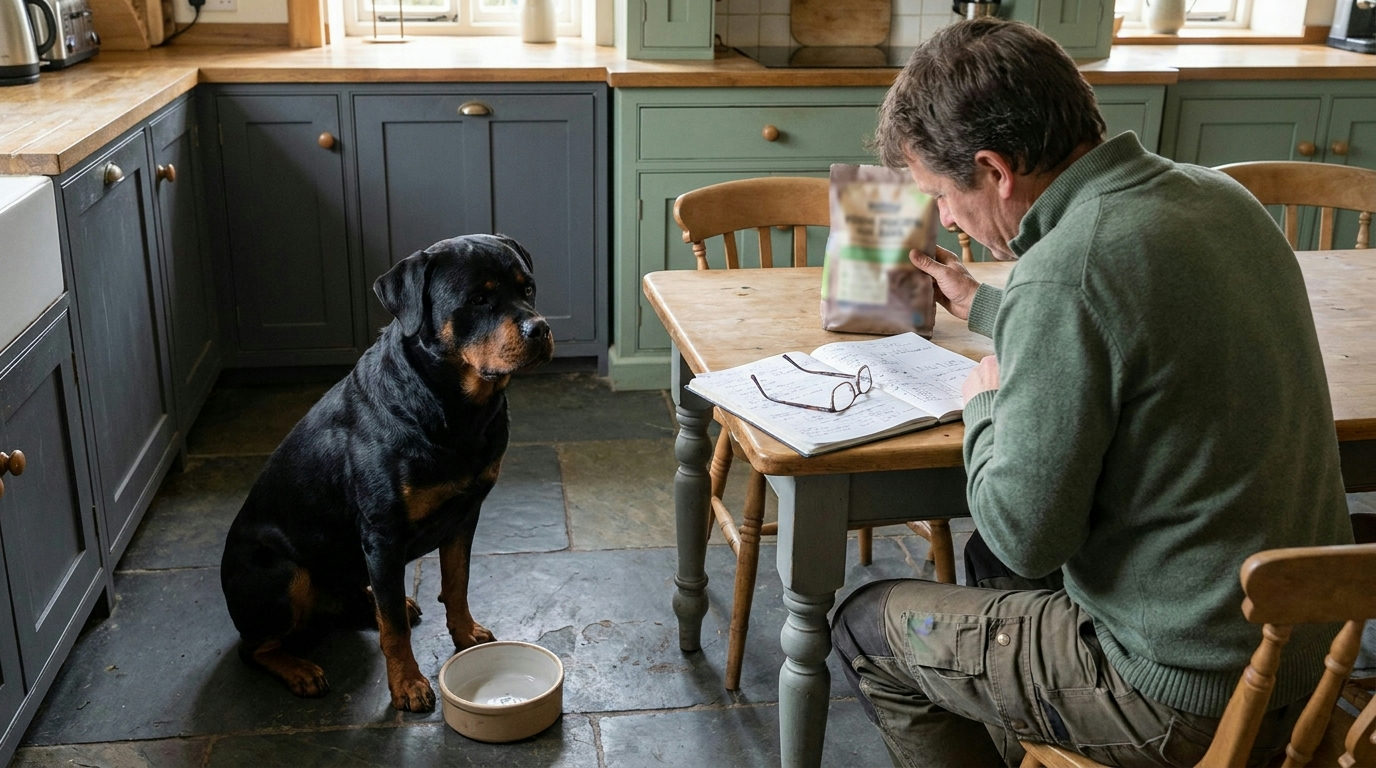
Interactive nutrition for your Rottweiler can begin with a feeding worksheet that you complete with your veterinary team. Record the actual food, amounts, extras and daily arrangement, then use those details to ask for an individual plan. You do not need to trust an unexplained calorie output or a promise that an online calculator can prescribe the perfect diet.
This is general information, not veterinary advice or a nutrition prescription. Consult a qualified veterinarian about suitable food, portions and monitoring for your dog. This guide does not announce a verified RottweilerDogGuide calculator or claim that a branded tool has been clinically validated. It offers a practical worksheet you can create in a notebook or ordinary spreadsheet.
Set one question for the worksheet
Write why you are reviewing feeding. Is the package recommendation confusing, are several people offering meals, or has your vet requested a nutrition review? Choose the main question and keep other concerns in a separate column. A worksheet is easier to use when you know what decision it is intended to support.
Record your dog’s identification, life stage and relevant veterinary instructions. Keep confirmed information distinct from your own assumptions. If you do not know a current weight or assessment, mark it unknown and ask how the team wants it obtained. Do not replace missing information with a breed-average number from an online discussion.
Avoid setting a target adult size because a photograph shows an impressive Rottweiler. Ask the team which measurements and condition observations matter for your individual dog. The worksheet should make uncertainty visible. A neatly filled form is not more useful than an honest one that identifies what needs assessment.
Enter the exact food rather than just the brand
Copy the full product name, formulation and package details. Photograph the nutritional adequacy statement and feeding guide so the team can review the same information you are using. Two foods under one brand may have different instructions. Make a separate entry for each product rather than treat them as interchangeable.
FDA guidance on complete and balanced food explains the nutritional adequacy statement and distinguishes growth and reproduction from adult maintenance. It also distinguishes a sole diet from products such as treats and supplements. Ask your vet whether the statement on your exact food suits your dog’s current life stage and care needs.
Do not use a front-of-pack word such as premium, natural or performance as a nutritional conclusion. Put it in a marketing-notes column if it interests you. The adequacy statement, exact formulation and individual veterinary assessment answer different questions from the package’s appeal. Keep those questions separate when comparing foods.
Record the routine actually being followed
Write the amount offered, the unit used and the usual meal arrangement. Distinguish a daily allowance from one meal’s portion. Ask every caregiver how they measure food and where they keep the instruction. If the household is using different cups or package portions, record the difference rather than assume they represent the same amount.
Include access to another animal’s meals and food used during training. Record a scoop you cannot quantify as an estimate. This is an observation task, not a reason to interrupt feeding with an improvised restriction. Ask the team how to obtain a clearer record if access cannot be measured in the current arrangement.
A hypothetical worksheet entry might say morning meal offered by one caregiver, evening meal offered by another, training food not yet measured. It is an example of identifying a gap, not a case study or a recommended feeding schedule. The next question is how those contributions should fit the agreed daily plan.
Keep energy values attached to their units
If the manufacturer supplies energy information, copy the value and its stated unit together. It may be expressed per kilogram, per package or by another measure. Do not enter an isolated number and expect a spreadsheet to infer its meaning. Ask the maker or veterinary team to explain anything that is missing or unclear.
For mixed feeding, list each food’s value separately. A daily recommendation on each package is not automatically a combined feeding prescription. Ask how the selected foods should be portioned together. A worksheet can display their names and quantities without pretending to calculate a complete nutrient profile from incomplete label data.
If you use a calculator elsewhere, save its inputs, output and stated assumptions for discussion. Do not assume that accepting age and activity inputs establishes clinical accuracy. An output can be an estimate with limitations; it does not replace an assessment of body condition or an individual plan for a medical concern.
Add condition assessment through the veterinary team
The WSAVA nutrition resources include body-condition and muscle-condition assessment tools. Ask your team to demonstrate the observations that apply to your Rottweiler. Record the date and the clinician’s explanation rather than assign a score from a photograph you have not been taught to interpret.
Keep any reliable weight records with dates and measurement details. A change on the scale is information to discuss, not an instruction to increase or cut food automatically. Ask how the team wants you to monitor progress and when it wants to reassess the plan. The dog’s frame and muscular appearance do not settle those questions.
Do not turn the worksheet into a diagnosis. An observation about appetite, movement or appearance belongs in its own column. If you notice a concerning change, contact the vet instead of repeatedly editing an activity category until the calculator gives a reassuring number. Record the advice received and the next step.
Describe activity instead of choosing a vague label
Write what a typical day includes: familiar walks, supervised play, training or an organised activity. Include rest days and recent changes. The description should let the team understand the arrangement without guessing what highly active means in your household. Do not convert a sport’s reputation into a calorie allowance.
If the dog has restrictions, put the clinician’s actual instruction beside the activity note. Tell the team about difficulty following it. A feeding worksheet should not be used to justify extra exercise, heat exposure or an improvised training challenge. Ask about appropriate activity and feeding together when the routine changes.
Use one dated activity record rather than several conflicting summaries. It can be brief, provided it describes the routine honestly. If the dog’s usual activity varies, explain the variation and ask whether the feeding plan needs a specific arrangement. Avoid making an automatic food adjustment from weather or one energetic outing.
Turn the advice into a shared feeding card
After the veterinary discussion, write the current food, daily amount, unit, meal arrangement and permitted extras. Keep the monitoring and review instructions alongside them. Ask the team to clarify any difference between the agreed plan and the package guide. Do not silently combine instructions that were intended as alternatives.
Give every caregiver the same dated card. Add a simple way to mark meals already offered. Retain older cards as history but identify which is current. When the plan changes, replace the household copy at the same time so a helper does not follow an earlier amount from a saved message.
Ask what to do if food becomes unavailable or the dog refuses it. Record the appropriate clinic contact. Do not substitute a similarly named product or add supplements because the worksheet seems incomplete. A missing answer is a question for the team, not a prompt to invent a feeding rule.
Review the worksheet without chasing precision
At the agreed review, bring the current card, actual feeding record and any requested observations. Identify which parts were easy to follow and which caused confusion. A practical issue such as an unclear measuring unit deserves clarification. The plan should be usable in the household, not merely look precise on a screen.
Interactive nutrition for your Rottweiler is useful when it turns scattered information into a clear conversation. Start with one question, record the exact food and real routine, then ask your veterinary team for the individual instruction. Keep the resulting card current and review concerns promptly. The worksheet supports care through accurate records; it does not promise a perfect diet or replace professional assessment.