By the Rottweiler Dog Guide editorial team.
Disclaimer: This article is for general educational purposes only and is not a substitute for professional veterinary or behavioral advice. Always consult your veterinarian or a qualified trainer about your own dogs.
Introducing a Rottweiler to another dog goes best when it is slow, planned and boring. Whether you are bringing home a second dog or adding a Rottweiler to a home that already has one, this page is a reading list plus a step-by-step plan. Open the primary pages first, write down what they say, and then work through the stages below at your dogs’ pace.
Primary pages to open first
Read those pages yourself. If this article and those pages ever disagree, follow the source pages, your vet and a qualified trainer.
What those pages emphasize (write it in your notebook)
Write the ideas in their words, not ours:
- The PetMD article describes introducing dogs gradually, starting on neutral ground rather than at home.
- It describes walking the dogs alongside each other and watching body language closely.
- It encourages owners to manage resources such as food, toys and beds to avoid tension.
- The AVMA page treats supervision and training as foundations of safety around dogs.
Do not invent timelines such as “friends in three days”. Every pair of dogs moves at its own pace.
What this guide covers, and what it does not
This guide covers preparation, a staged introduction plan, home setup, managing food and toys, and the signs that mean you should pause or get help. It does not assess whether two particular dogs will get along, does not cover dogs with a history of fighting, and does not diagnose behavior problems. If either dog has shown aggression toward other dogs, speak to a qualified trainer or behavior professional before any introduction.
Before the first meeting
- Book a vet check for both dogs. Pain or illness can make a dog less tolerant.
- Ask your vet whether both dogs are up to date on vaccines and parasite prevention.
- Talk to a qualified trainer if either dog has any history of tension with other dogs.
- Recruit a calm second adult. You will need one handler per dog.
- Choose a quiet, neutral place for the first meeting, such as a quiet street or open space neither dog uses regularly.
- Set up the home before the new dog arrives (see below).
Set up the home first
Prepare the house so the dogs can live separately for a while if needed:
- Two separate feeding areas, ideally in different rooms
- Two beds or crates, placed apart
- Baby gates to divide the house into zones
- Toys and chews put away for now, to be added back slowly
- A quiet space for each dog to retreat to
Having this ready means you never have to rush the process.
Stage one: a parallel walk on neutral ground
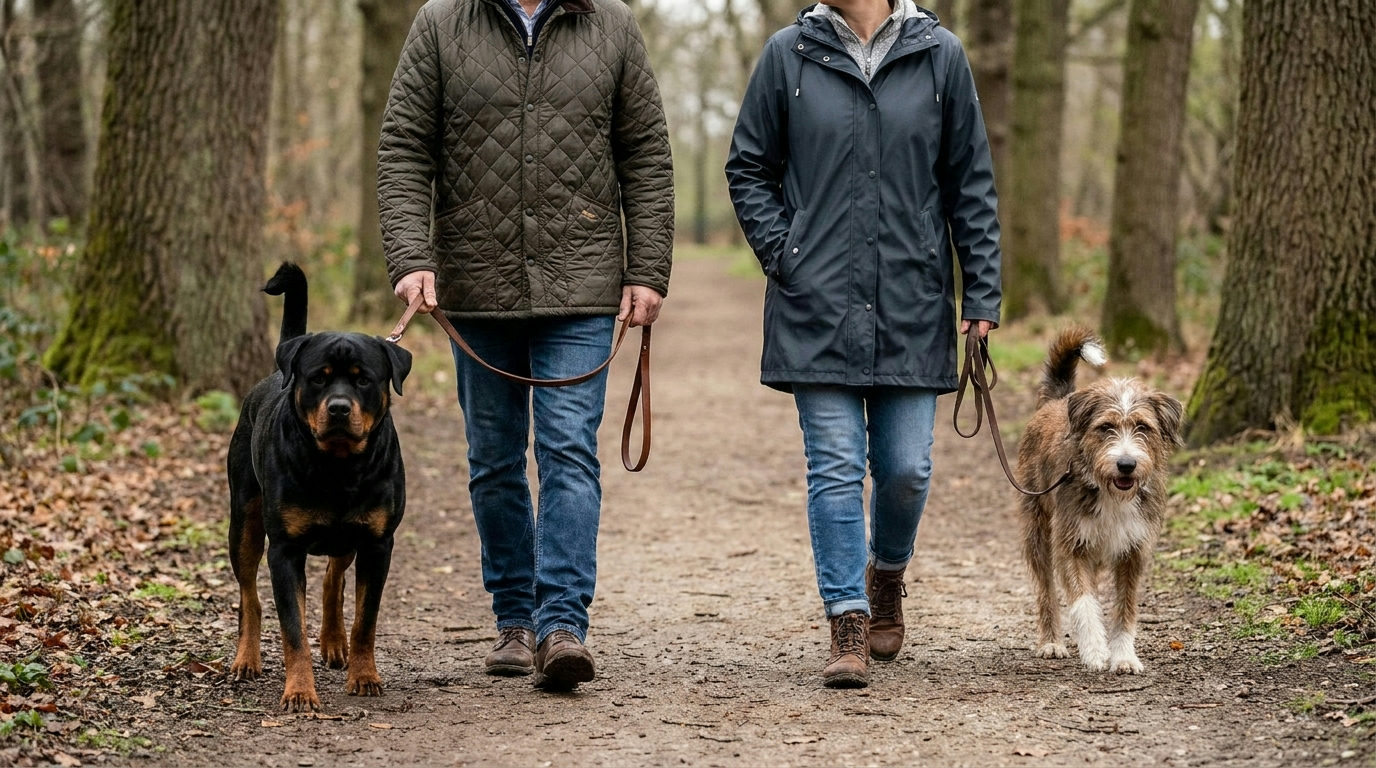
The PetMD article describes starting on neutral ground. A parallel walk is a common way to do this:
- Each handler walks one dog on a secure leash.
- Start far enough apart that both dogs stay relaxed.
- Walk in the same direction, with plenty of space between you.
- Reward calm behavior with treats and praise.
- Slowly reduce the distance over the walk, only as long as both dogs stay relaxed.
- Keep the first walk short and end on a calm note.
Keep leashes loose where you safely can. A tight leash can add tension.
Stage two: a brief, calm greeting
If both dogs stayed relaxed on the walk, you can allow a very short greeting:
- Let them sniff for a few seconds only.
- Then calmly call each dog away and reward.
- Repeat a couple of times if things stay relaxed.
- Keep moving rather than standing still in a face-off.
If either dog stiffens, stares or growls, calmly increase the distance and end the session. Try again another day, or ask a trainer to help.
Stage three: arriving home
- Walk both dogs together toward the house.
- Let the resident dog enter first, then the new dog.
- Keep leashes on for the first period indoors so you can guide them.
- Use baby gates so the dogs can see each other without full contact.
- Give each dog time alone in its own space.
Stage four: the first weeks together
Move slowly from separated to shared time. A gradual plan might look like this:
- Short supervised sessions in the same room, with both dogs on leashes or behind gates
- Gradually longer supervised sessions as both dogs stay relaxed
- Separate rest times every day
- Separate feeding at all times
- Toys added back one at a time, under supervision
Keep the dogs separated whenever you cannot supervise, at least until you and your trainer are confident.
Managing food, toys and resting places
The PetMD article highlights resources as a common source of tension. Simple management helps a lot:
- Feed the dogs in separate rooms and pick up bowls afterwards.
- Give long-lasting chews only when the dogs are apart.
- Have enough beds that neither dog has to share.
- Watch for one dog guarding a doorway, sofa or person.
- Remove high-value toys if they cause stiffness or staring.
Signs to pause and get help
Pause the introductions and contact a qualified trainer or your vet if you notice:
- Stiff posture, hard stares or freezing
- Growling, lip lifting or snapping
- Guarding of food, toys, beds or people
- One dog constantly avoiding or hiding from the other
- Any scuffle, even a short one
Asking for help early is responsible, not a failure. A professional can watch both dogs and suggest changes.
Keep a short introduction diary
Each day, write a few lines: what you did, how long it lasted, how each dog behaved, and anything that caused tension. This helps you notice progress, and it gives a trainer clear information if you need help. Our guide to balanced Rottweiler behavior has more ideas for calm daily routines.
Questions to ask your vet or trainer (write their answers)
- Are both dogs healthy and comfortable enough for introductions?
- Based on their histories, how slowly should we go?
- Which body language signals should I watch most closely for each dog?
- How should we manage feeding and toys in the first months?
- When would you suggest bringing in a behavior professional?
FAQ
How long does it take for two dogs to get along?
This guide does not give a timeline. Go at your dogs’ pace, and use your diary to track progress.
Should I let them “sort it out”?
No. This guide suggests calm, supervised steps and professional help if tension appears.
Is a second Rottweiler a good idea?
This guide does not make that call for you. Talk to a trainer and your vet about your current dog’s needs first.
Is this professional advice?
No. It is a reading list plus a staged checklist.
What not to do
- Do not hold the first meeting in a small room at home.
- Do not feed the dogs side by side in the early weeks.
- Do not leave the dogs alone together until you and your trainer are confident.
- Do not punish growling. Increase distance and get help.
Closing tip
This week, open the PetMD and AVMA pages, set up separate feeding and resting areas, and plan a short parallel walk with a calm helper. Introducing a Rottweiler to another dog works best when you treat it as a gradual process, not a single meeting.