By the Rottweiler Dog Guide editorial team.
Disclaimer: This article is for general educational purposes only and is not a substitute for professional veterinary advice, diagnosis or treatment. Always consult your veterinarian about your own dog.
Rottweiler dental care is easy to forget until bad breath or a broken tooth forces the issue. This page is a reading list plus a home checklist. Open the primary pages first, write down what they say, and then use the routine below to build a habit your dog can live with.
Primary pages to open first
Read those pages yourself. If this article and those pages ever disagree, follow the source pages and your veterinarian.
What those pages emphasize (write it in your notebook)
Write the ideas in their words, not ours:
- The AVMA page treats dental care as part of routine pet health, not an optional extra.
- It lists warning signs owners can watch for at home, such as bad breath and changes in eating.
- It describes regular veterinary dental checks as part of the plan.
- The VOHC site lists products that have been reviewed against its own standards.
Do not invent statistics about how many dogs have dental disease, or how fast it progresses. Those belong with your vet, not a blog.
What this guide covers, and what it does not
This guide covers a home brushing routine, a weekly mouth check, how to read a product label against the VOHC list, and questions to ask at your next appointment. It does not diagnose dental disease, recommend anesthesia decisions, name medicines or give doses. Those decisions belong with your veterinarian.
Your Rottweiler dental care kit
- A dog toothbrush or finger brush: pick a size that fits your dog’s mouth comfortably.
- Toothpaste made for dogs: never human toothpaste. Ask your vet which type suits your dog.
- Small soft treats: to reward calm behavior during practice.
- A towel and a quiet spot: somewhere your dog already relaxes.
- A notebook: for your weekly mouth check and your vet’s answers.
This page does not recommend brands. If you want a chew or rinse, check whether it appears on the VOHC list and ask your vet whether it suits your dog.
A step-by-step brushing plan
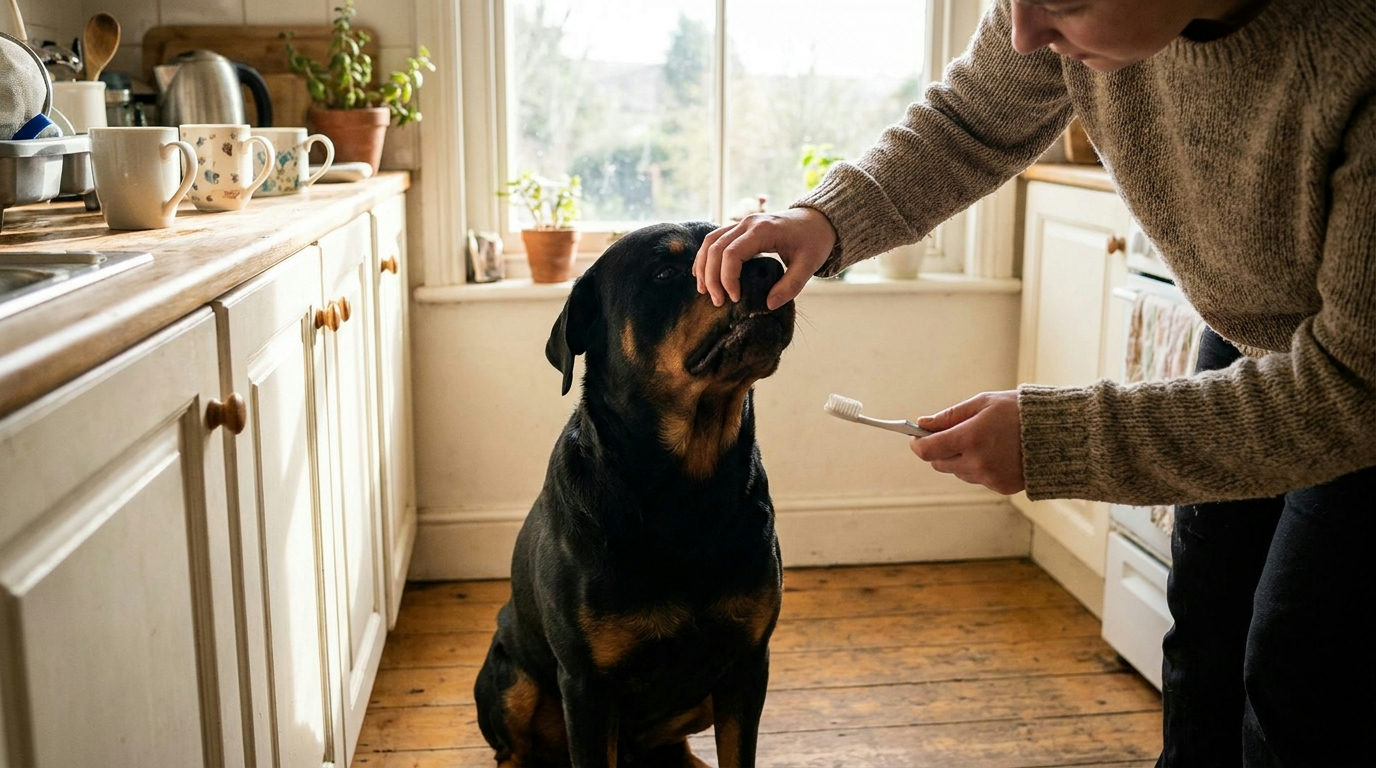
Go slowly. The goal of the first week is a relaxed dog, not clean teeth.
- Day 1–2: Let your dog lick a little dog toothpaste from your finger. Reward and stop.
- Day 3–4: Gently lift the lip for a second or two. Reward and stop.
- Day 5–6: Rub a finger along the outside of a few front teeth. Reward and stop.
- Day 7 onward: Introduce the brush on a few teeth, then slowly add more each session.
- Every session: Keep it short and end before your dog pulls away.
If your dog shows pain, flinches hard, or will not let you near one side of the mouth, stop brushing and book a vet visit. Do not push through discomfort.
A weekly mouth check
Once a week, lift the lips in good light and write down what you see. Note any of the following, and bring the notes to your vet:
- Breath that smells worse than usual
- Red, swollen or bleeding gums
- Brown or yellow build-up on the teeth
- A chipped, cracked or loose tooth
- Chewing on one side, dropping food, or pawing at the mouth
- Any lump, sore or swelling in the mouth or on the face
The AVMA page lists warning signs like these. It is worth reading the full list there and keeping it next to your notebook.
Questions to ask your vet (write their answers)
- How do my dog’s teeth and gums look today?
- How often do you recommend I brush at home?
- Which toothpaste type do you suggest for my dog?
- Are there any chews or toys I should avoid for my dog’s teeth?
- Do you recommend a professional dental cleaning, and what does it involve at this clinic?
- What signs should make me call you before the next appointment?
Write the answers in your vet’s words. Keep them with your dog’s records so everyone in the house follows the same plan.
Puppies, adults and seniors
Start the toothpaste-taste step as early as your vet says is suitable. A puppy that learns lip lifts and gentle touches early often finds brushing ordinary later on. For adults, the same plan works; just expect the first week to take a little longer if your dog has never had its mouth handled. For older dogs, keep sessions extra short and gentle, and raise any new mouth changes at each check-up. In every case, your vet is the right person to tell you what your own dog needs at its age.
Reading product labels without guessing
Dental products often make big promises on the packet. Here is a simple way to check:
- Look for the product name on the VOHC website.
- If it is not there, treat the packet claim as marketing, not evidence.
- Ask your vet whether the product is suitable for a dog of your Rottweiler’s size and chewing style.
- Supervise your dog with any new chew until you know how they use it.
This article does not rank products. The VOHC list and your vet are the places to make that choice.
Chewing safety at home
Chew choice is a question to raise with your vet rather than a guess at the pet store. Until you have their answer, follow these simple house rules:
- Supervise new chews.
- Take away chews that have worn small enough to swallow.
- Remove anything that has splintered or cracked.
- Stop and call your vet if your dog seems to be in pain after chewing.
Make it part of the routine
Habits stick when they are attached to something you already do. Some owners brush after the evening walk. Others do it right after dinner clean-up. Write the time on the fridge note and agree who does it on which days. If more than one person helps, show them the same step-by-step plan so your dog gets a consistent experience.
For more everyday care routines, read our essential Rottweiler grooming tips.
When to call the vet
Call your clinic rather than waiting for the next routine visit if you notice:
- A broken or loose tooth
- Bleeding from the mouth
- Swelling on the face or under the eye
- Your dog refusing food or struggling to chew
- Pawing at the mouth or crying when eating
Do not give human pain medicine. Ask your vet first.
FAQ
Can I use human toothpaste?
No. Use a toothpaste made for dogs, and ask your vet which type suits your dog.
How often should I brush?
Ask your vet and write down their answer. This article does not set a schedule.
Do dental chews replace brushing?
Ask your vet. If you use chews, check them against the VOHC list and supervise.
Is this veterinary advice?
No. It is a reading list plus a home checklist.
What not to do
- Do not invent disease statistics or “guaranteed fresh breath” claims.
- Do not scrape tartar off at home with sharp tools.
- Do not ignore a broken tooth because your dog is still eating.
- Do not skip the primary AVMA and VOHC pages and rely on social clips alone.
Closing tip
This week, open the AVMA dental page and the VOHC site, write five notes in their words, then do one short toothpaste-taste session with your dog and stop on a good note. Rottweiler dental care becomes easy when it is small, calm and regular.