By the Rottweiler Dog Guide editorial team.
Disclaimer: This article is for general educational purposes only and is not a substitute for professional veterinary or behavioral advice. Always consult your veterinarian or a qualified trainer about your own dog and your own family.
Rottweilers and children can share a happy home, but it does not happen by accident. A family dog needs clear rules, adult supervision and a quiet place to rest. Children need simple rules too. This page is a reading list plus a family checklist. Open the primary pages first, write down what they say, and then set up the house rules below together.
Primary pages to open first
Read those pages yourself. If this article and those pages ever disagree, follow the source pages, your vet and a qualified trainer.
What those pages emphasize (write it in your notebook)
Write the ideas in their words, not ours:
- The AVMA bite prevention page treats supervision and education as the foundations of safety around dogs.
- It encourages teaching children how to behave around dogs, including dogs they know.
- It encourages owners to socialize and train their dogs and to seek help for concerning behavior.
- The AKC breed page describes the Rottweiler as a large, strong working breed, which is useful context for planning supervision.
Do not invent statistics about bites, breeds or ages. This page does not compare breeds or rank risk.
What this guide covers, and what it does not
This guide covers house rules for children, supervision plans, safe spaces for the dog, introductions with a new baby, visiting friends and the signs that mean you need a professional. It does not assess any individual dog’s temperament, does not diagnose behavior problems and does not give legal advice about dog ownership. If you are worried about your dog’s behavior, contact your vet or a qualified trainer before anything else.
The golden rule: active adult supervision
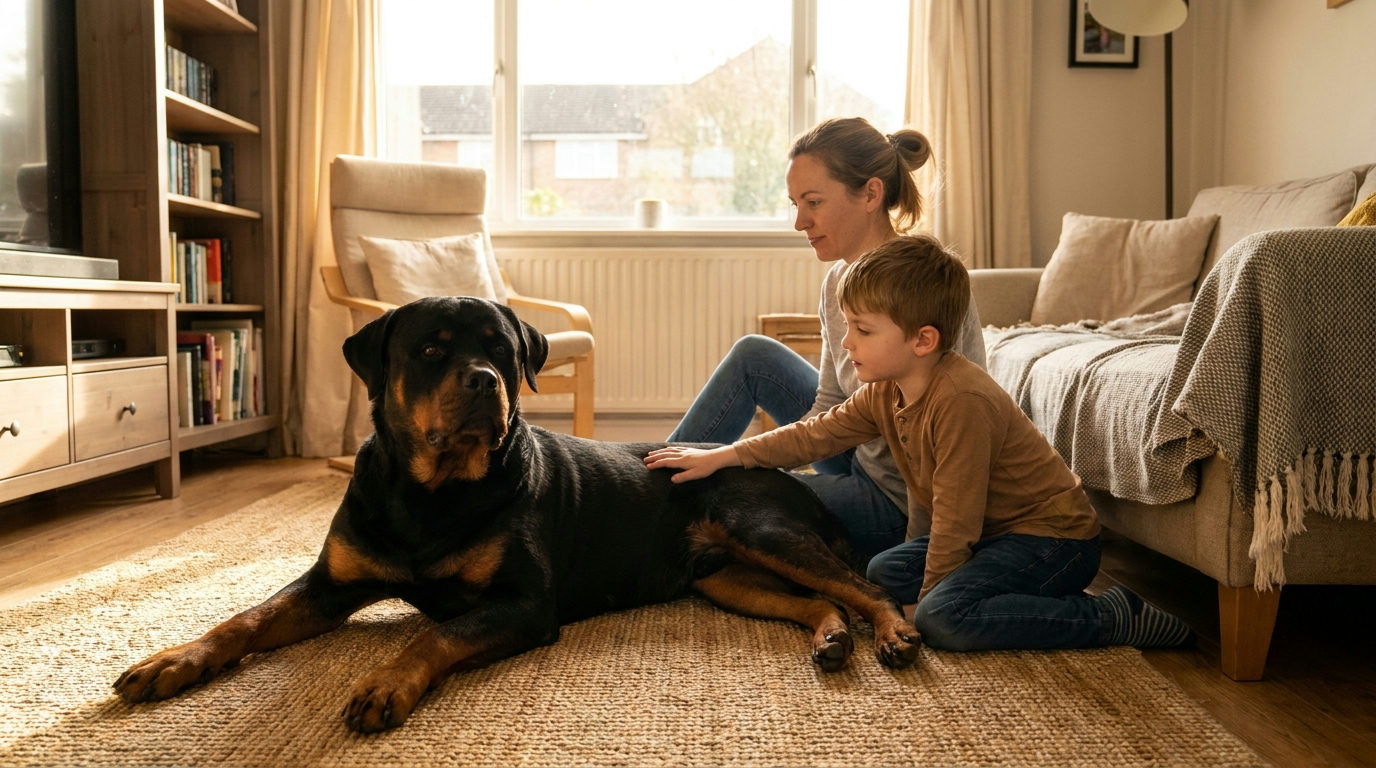
Every rule on this page rests on one idea: an adult is actively watching whenever a child and the dog are together. “Actively” means you are in the room and paying attention, not looking at a phone or cooking with your back turned.
When you cannot supervise, separate. Use a closed door, a baby gate or a crate your dog already likes. Separation is not a punishment. It is simply what keeps everyone safe when your attention is elsewhere.
A simple supervision plan
- Write down the times of day when the household is busiest, such as school mornings and dinner.
- Plan for the dog to be in its quiet space during those times.
- Agree which adult is “on duty” whenever the dog and children share a room.
- Use a clear handover phrase, such as “You have the dog now,” so supervision never falls between two people.
House rules for children
Keep the rules short, and practise them like a game. Write them on a card by the door:
- Ask an adult before touching the dog.
- Let the dog come to you. Do not chase it.
- Stroke the dog’s side or chest gently, not the face or tail.
- No hugging, climbing on or riding the dog.
- Leave the dog alone when it is eating, chewing, sleeping or in its bed.
- Never take a toy or bone from the dog. Ask an adult instead.
- If the dog seems worried or grumpy, walk away calmly and tell an adult.
Read the AVMA page with older children so they can see the advice comes from veterinarians, not just from you.
Give your dog a safe space
Every family dog needs a place where it will not be disturbed. Set one up like this:
- Choose a quiet corner, room or crate area away from the busiest part of the house.
- Add a comfortable bed, water and an approved chew.
- Make the rule clear: when the dog is in its space, children leave it alone.
- Use a baby gate so the dog can see the family but children cannot follow it in.
A dog that knows it can always retreat is easier to live with. Respecting that space is one of the most useful habits a child can learn.
Learn to read your dog’s signals
Dogs often show they are uncomfortable before things escalate. Ask your vet or trainer to walk you through your own dog’s signals, and write them down. Many families find it useful to watch for changes such as:
- Turning the head away or moving away
- Licking lips or yawning when not tired
- Showing the whites of the eyes
- Going stiff or very still
- Tucking the tail or lowering the body
- Growling or lifting a lip
If you see these, calmly give the dog space and redirect the child. Never punish a growl. Instead, treat it as useful information, and talk to a professional about what caused it.
Training that helps family life
Training gives your dog clear jobs and gives you calm ways to manage busy moments. Useful skills to build with a qualified trainer include:
- Going to its bed or mat on cue
- Sitting calmly for greetings
- “Leave it” for dropped food and toys
- Walking politely on a leash
- Waiting at doors and gates
Older children can join training sessions with an adult, using treats and gentle cues. It helps the dog see children as calm, predictable people. Our guide to balanced Rottweiler behavior has more routine ideas.
Bringing home a new baby
A new baby changes everything about a dog’s day. Start preparing well before the due date:
- Book a vet check so any health concerns are dealt with early.
- Talk to a qualified trainer about your dog’s current habits.
- Set up the baby’s room and gates ahead of time, so the dog adjusts slowly.
- Practise the new daily routine, including walks at different times.
- Plan who will care for the dog during the birth and the first days home.
When the baby comes home, keep greetings calm and supervised. Never leave the baby and the dog together unsupervised, even for a moment.
When friends visit
Visiting children do not know your house rules. Before they arrive:
- Decide whether the dog will join the visit or stay in its safe space.
- Explain the house rules to the visiting children and their parents.
- Keep the dog in its space during excited games, parties and meals.
- Check on the dog regularly, and give it a chew to enjoy quietly.
When in doubt, keep the dog separate. It is the simplest way to keep a busy day calm.
Questions to ask your vet or trainer (write their answers)
- Does my dog show any signs of pain or discomfort that could affect its behavior?
- Which signals does my own dog use when it is uncomfortable?
- What training would help our family most right now?
- How should we prepare our dog for a new baby or a new child in the home?
- What should we do if our dog growls at a child?
When to get professional help
Contact your vet and a qualified trainer promptly if you notice growling, snapping, guarding of food or toys, stiffness around children, or any situation where you feel uneasy. Asking early is responsible ownership, and it is always easier to solve a small concern than a large one.
FAQ
Are Rottweilers good with children?
Every dog is an individual. This guide does not make breed promises. Supervision, training and clear rules matter for every family dog.
At what age can my child walk the dog?
This guide does not set an age. Consider your child’s strength and your dog’s training, and ask a trainer before handing over the leash.
Is this professional advice?
No. It is a reading list plus a family checklist.
What not to do
- Do not leave babies or young children alone with any dog.
- Do not punish growling. Get help instead.
- Do not let children hug, climb on or tease the dog.
- Do not skip the AVMA page and rely on assumptions.
Closing tip
This week, read the AVMA bite prevention page as a family, write the house rules on a card by the door, and set up your dog’s safe space. With supervision, clear rules and early help when needed, Rottweilers and children can build a calm, respectful home together.