For many dedicated Rottweiler owners, the journey of responsible pet ownership often leads to understanding and addressing complex behavioral challenges. One such challenge, Rottweiler reactive training, is a nuanced area that demands patience, consistency, and an empathetic approach. As the humanization of pets continues to drive demand for specialized, trustworthy information, understanding how to effectively manage reactivity in your Rottweiler is more crucial than ever. This in-depth guide provides evidence-based strategies to help you navigate reactive behaviors, fostering a calmer, more confident companion.
Understanding Reactivity in Rottweilers
Reactivity in Rottweilers typically manifests as an exaggerated response to certain triggers, such as other dogs, strangers, or specific environmental stimuli. Unlike aggression, which is often intentional, reactivity is usually rooted in fear, anxiety, frustration, or over-excitement. Given the Rottweiler’s powerful build and protective instincts, reactive behaviors can be concerning for owners and the public alike. Therefore, it’s essential to recognize that reactivity is not a sign of a ‘bad’ dog, but rather a communication of discomfort or overstimulation. Addressing this requires a commitment to positive reinforcement and a deep understanding of your dog’s individual triggers.
The Roots of Reactive Behavior
Several factors can contribute to a Rottweiler developing reactive tendencies. First, genetics can play a role; some lines may be predisposed to higher anxiety levels. Second, early socialization experiences are critical. A lack of positive exposure to various sights, sounds, people, and other dogs during puppyhood can lead to fear-based reactions later on. Third, past negative experiences, such as an attack by another dog or harsh training methods, can also trigger reactivity. Furthermore, environmental stressors, insufficient exercise, or even underlying medical conditions can exacerbate these behaviors. It is important to consult with a veterinarian to rule out any health issues before embarking on a behavior modification plan.
Identifying Your Rottweiler’s Unique Triggers
Careful observation is the cornerstone of effective behavior modification. To begin, keep a detailed log of when and where your Rottweiler exhibits reactive behaviors. Note the specific stimuli present, such as other dogs (their size, breed, or demeanor), people (wearing hats, carrying bags, or running), sounds (loud trucks, alarms), or even specific locations. For example, does your dog react more strongly in crowded areas compared to quiet parks? Understanding these patterns will allow you to predict potential issues and proactively manage situations. Moreover, recognizing subtle pre-reaction cues, like a stiff body, fixed stare, or whale eye, enables you to intervene before a full reaction occurs.
Key Principles of Effective Rottweiler Reactive Training
Successful Rottweiler reactive training hinges on several core principles:
- Identify Triggers and Thresholds: Observe your Rottweiler closely to pinpoint exactly what causes their reactive responses. Is it specific breeds of dogs? People wearing hats? Loud noises? Also, understand their ‘threshold’ – the point at which they can no longer cope and react. Training should always occur below this threshold.
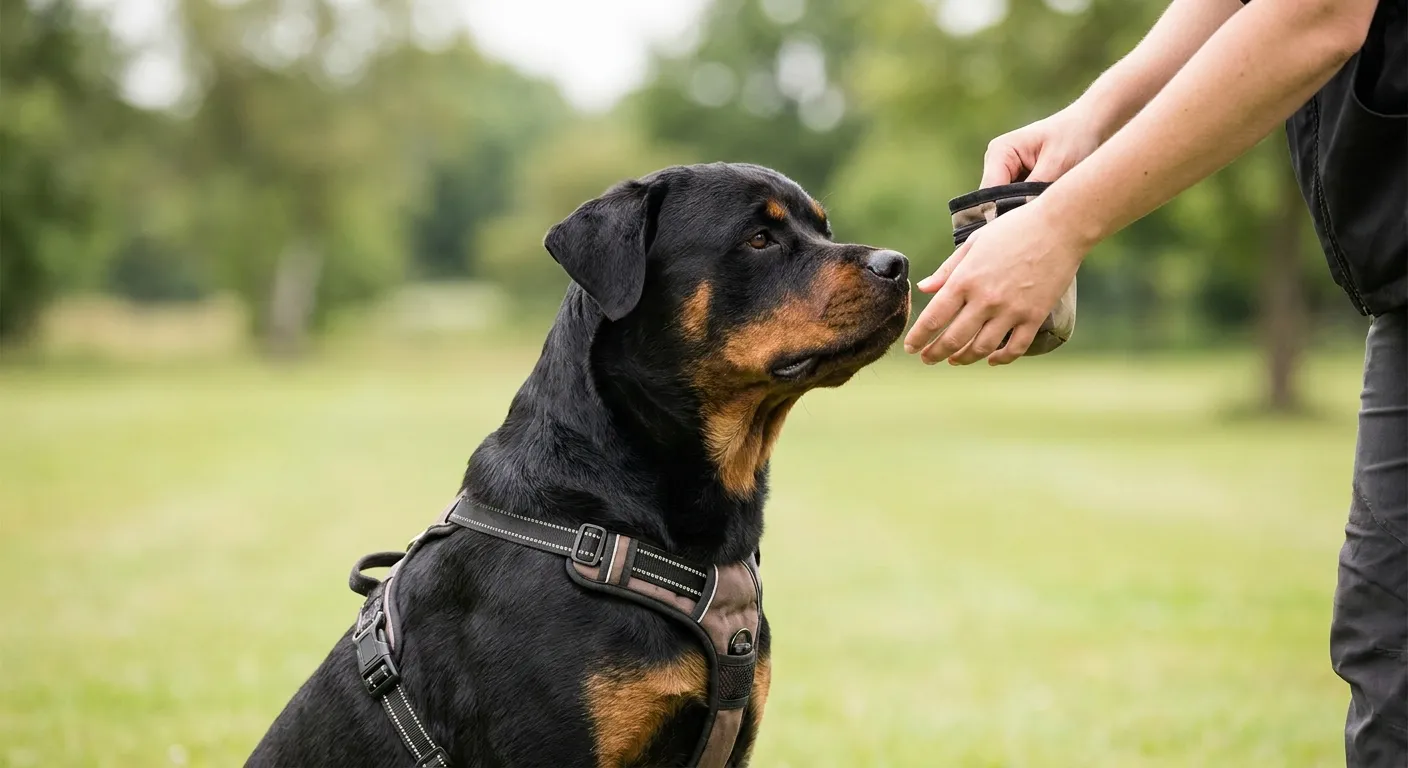
- Positive Reinforcement: This is paramount. When your Rottweiler notices a trigger but remains calm or looks to you, reward them immediately with high-value treats or praise. This helps them associate the presence of the trigger with positive outcomes.
- Management and Prevention: Until training is effective, manage your Rottweiler’s environment to prevent reactive incidents. This might mean walking at off-peak hours, using visual barriers, or avoiding known trigger zones. Prevention prevents practice of the unwanted behavior.
- Desensitization and Counter-Conditioning: Gradually expose your Rottweiler to triggers from a distance where they remain calm (desensitization), while simultaneously creating a positive association (counter-conditioning). For example, if your dog reacts to other dogs, start by observing another dog from a far distance, rewarding calm behavior, and slowly decreasing the distance over many sessions.
Setting Up Your Training Environment for Success
Creating a controlled and safe training environment is crucial for your Rottweiler. Initially, this means working in quiet areas with minimal distractions. As your dog progresses, you can gradually introduce more challenging environments. Consider using a long line in an enclosed space to practice recall and engagement exercises without the pressure of an off-leash park. Furthermore, ensure you have an ample supply of high-value treats that your Rottweiler absolutely loves; these will be your primary communication tool during counter-conditioning. A comfortable and secure harness, such as those found in our Training & Control Gear section, is also essential for safe handling.
The Importance of Consistency and Patience
Modifying reactive behavior is not a quick fix; it requires immense patience and unwavering consistency. Reactive behaviors have often been practiced for a long time, so it will take time to establish new, positive associations. Celebrate small victories, such as your Rottweiler noticing a trigger without barking, or looking at you for guidance. Do not get discouraged by setbacks; they are a normal part of the learning process. Instead, reassess your approach, perhaps increasing the distance from the trigger or using even higher-value rewards. Remember, your calm demeanor will also help your dog remain calm.
Practical Strategies for Reactive Rottweilers
1. Leash Handling Techniques
A well-fitting, comfortable harness (a front-clip can be helpful for reducing pulling) and a sturdy leash are fundamental tools. Learn to use the leash effectively without jerking or punishing your dog, which can increase anxiety. Instead, practice loose-leash walking in calm environments. When a trigger appears, gently guide your Rottweiler away or create distance. The goal is to maintain control while allowing them to feel secure. Consistent positive reinforcement for walking calmly, even in the presence of mild distractions, is vital. You can find excellent options for Training & Control Gear on our site.
2. Engage-Disengage Game
This is a powerful counter-conditioning exercise for Rottweiler reactive training. When your Rottweiler spots a trigger (e.g., another dog) at a distance where they are still calm, mark the moment they notice it (e.g., with a verbal