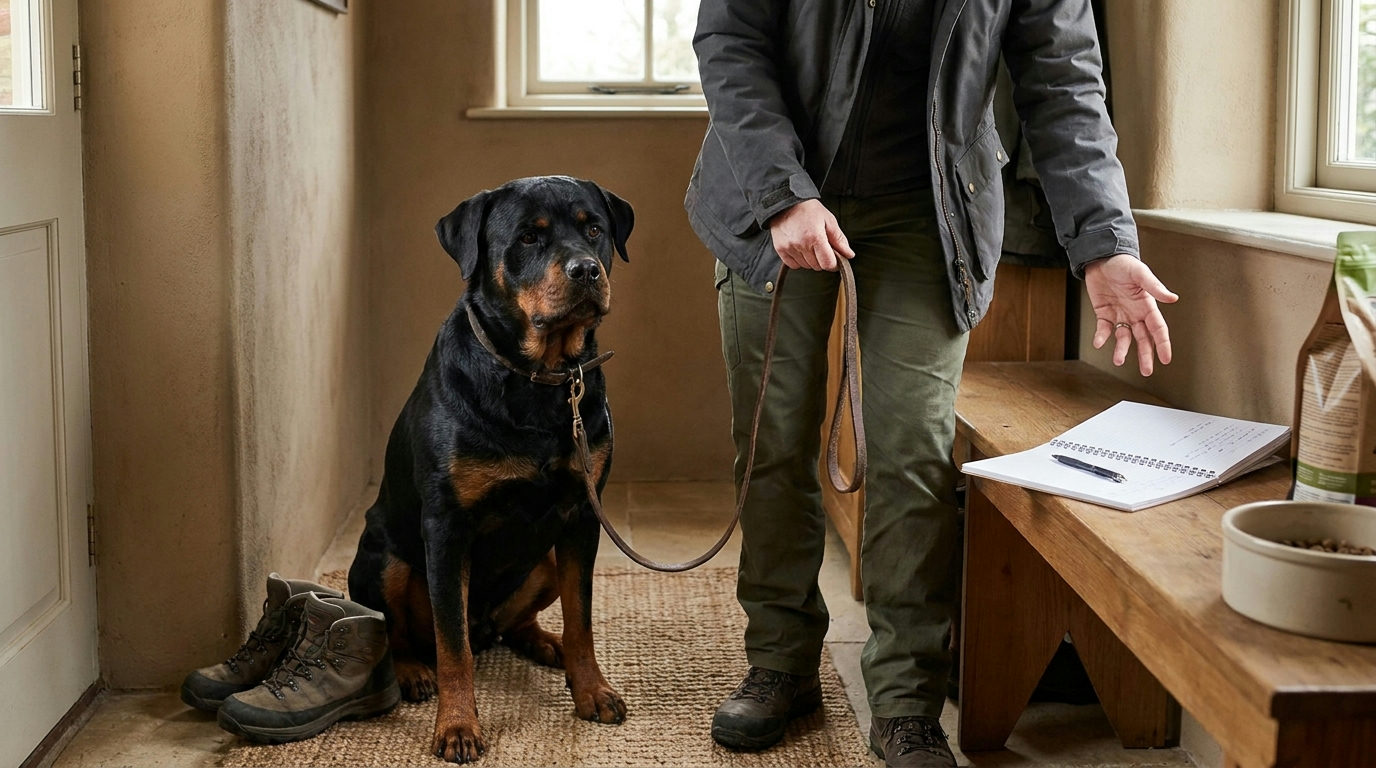
The best diet for your active Rottweiler is an individual feeding plan you can measure and review with your veterinarian. Describe what active actually means for your dog, identify the exact food and account for meals and rewards together. A powerful build, a sport label or a high protein percentage does not establish the correct portion by itself.
This is general information, not veterinary advice or an individual nutrition prescription. Ask a qualified veterinarian about suitable feeding and activity for your Rottweiler, including any health restrictions. This guide offers a planning worksheet rather than tested product rankings, a homemade recipe or a guarantee that a food improves athletic performance.
Describe the work before choosing a performance food
Write a typical activity day in ordinary terms. Include familiar walks, training, supervised play, organised sport and rest. State what the dog actually does rather than use a vague description such as very energetic. If the routine varies, record an ordinary day and the change you want the team to consider.
Keep planned activity distinct from current activity. Registering for a class does not mean the dog is already doing the work described by its advertising. Ask about appropriate preparation before changing feeding for the anticipated routine. A food decision should relate to the actual individual plan, not an imagined future workload.
List any existing activity restrictions and the instructions from the treating team. Do not increase exercise to justify a performance food or change food to avoid discussing difficulty during activity. If the dog appears uncomfortable or its capacity changes, report the observation. A breed reputation cannot determine what work is appropriate for this Rottweiler.
Take an accurate feeding history to the review
Copy the full name and formulation of every food. Photograph the nutritional adequacy statement, feeding guide and energy information. Write the amounts actually offered and the measuring units used. A brand name alone can obscure differences between products sold for different life stages or purposes.
Include training rewards, chews, toppers and supplements. Ask each caregiver what is offered outside the main meals. If the dog can eat another animal’s food, record that access. The team needs the complete routine rather than only the amount the main caregiver places in the usual bowl.
Mark uncertain quantities as estimates and identify where better information is needed. You do not have to reconstruct an exact historic intake to begin a review. A useful first step is making the current arrangement visible so the team can tell you what to measure next and how to do it consistently.
Match nutritional adequacy to the individual life stage
FDA guidance on complete and balanced food explains the role of the nutritional adequacy statement and distinguishes growth and reproduction from adult maintenance. It also distinguishes a sole diet from treats and supplements. Locate the statement on the exact product and ask whether it suits your dog’s current needs.
An active puppy still needs a life-stage discussion; activity does not turn adult-maintenance food into a growth diet. Likewise, a performance or large-breed label does not automatically establish suitability for every adult. Keep the life-stage statement beside the product name rather than rely on the front-of-pack image.
If a clinician recommends a therapeutic diet or another specific approach, ask how it fits the activity plan. Do not replace it with a sport food because a general article describes extra energy needs. Bring the comparison to the treating team. Its individual instruction should guide the decision where health concerns are involved.
Assess condition rather than aim for a breed maximum
The WSAVA nutrition resources provide body-condition and muscle-condition assessment tools. Ask your veterinary team to demonstrate the assessment that applies to your dog. A large frame or muscular appearance is not a substitute for learning what the clinician is assessing and why.
Bring reliable weight records with dates if available. Ask which future observations should be recorded, how they should be obtained and when the team wants to review them. Do not set a target from an online Rottweiler weight range or a photograph of a competition dog. The target should belong to your individual dog’s plan.
If a change in feeding is recommended, request the exact amount and monitoring arrangement. Avoid automatic increases after one strenuous outing or sharp reductions after a quiet day. Ask whether the team’s plan distinguishes different activity days and how that should be managed. The household needs an instruction it can actually follow.
Read the energy unit before comparing servings
Copy the manufacturer’s energy information with its unit attached. It may be stated per kilogram, package or another measure. A serving size is not meaningful without knowing which product and unit it describes. Ask the maker or vet to clarify missing information instead of comparing two unlabelled scoop sizes.
Keep amounts offered for each food in separate worksheet entries. If you combine foods, ask how their portions fit the daily allowance. The full daily guide from each package should not automatically be added together. A mixed-feeding plan needs clear amounts for the selected products rather than a universal wet-to-dry ratio.
Do not build a breed-specific nutrient rule from isolated percentages on labels. FDA notes that comparisons across foods with different moisture levels need an appropriate common basis. Ask which comparison matters for the feeding question. A printed protein percentage does not establish a performance benefit or a guarantee of stronger muscles.
Make training rewards part of the day
Record the food used during training and ask the team how suitable rewards belong within the allowance. Keep that arrangement visible to the trainer and other caregivers. A busy training day can involve several people offering food, so counting only the ordinary bowl meals may leave part of the routine unrecorded.
When practical and appropriate to the veterinary plan, prepare the agreed reward portion before the session. Label it for the current task and record what was used. This is an organisational method, not a recommendation to withhold meals or turn every activity into food work. Ask for help if the arrangement creates confusion or the dog cannot comfortably take part.
Keep chews and supplements identified as well. Do not assume that a joint-labelled item is necessary because the dog exercises or that an energy topper is needed after every outing. Bring the exact product and intended purpose to the team. The plan should account for what is actually being given.
Plan activity-day logistics without a universal timing rule
Ask your vet or qualified activity professional how feeding and the specific activity should be arranged for your dog. Record those instructions with the day’s plan. This article does not prescribe a fixed waiting interval, a compulsory meal count or a universal post-exercise supplement. Different circumstances need individual guidance.
Keep familiar food and care supplies available when travelling for an activity. Follow the product’s storage instructions and the venue’s relevant rules. If the normal routine cannot be maintained, ask in advance what arrangement is appropriate. Do not discover at the event that nobody knows which food or amount to offer.
Make water access part of the discussion and follow any individual clinical instructions. Avoid treating thirst or appetite as a test of whether the food is optimised. Record a concerning change and contact the team. A new diet cannot resolve every issue associated with exercise, transport or an unfamiliar setting.
Store and change food through one current instruction
FDA’s handling advice includes clean utensils, dry food retained in its original bag and prompt refrigeration or disposal of unused canned or pouched food. Follow the specific package instructions and keep identification and lot information available. An unlabelled travel container should not be the only record of the food.
If a food change is appropriate, ask for transition instructions for these products and this dog. Record what should prompt a call if the response is concerning. Do not copy a universal percentage sequence or duration from another animal’s plan. Update the feeding card at the same time so every caregiver follows the same current arrangement.
Keep the daily allowance, reward arrangement, activity-day instruction and review date together. At follow-up, explain what was straightforward and what was difficult to maintain. The best diet for your active Rottweiler is a usable individual plan, supported by accurate labels and observations. Begin with the actual activity and feeding history, ask for clear amounts and review changes with your veterinary team instead of chasing a promised performance formula.