By the Rottweiler Dog Guide editorial team.
Disclaimer: This article is for general educational purposes only and is not a substitute for professional veterinary advice, diagnosis or treatment. Always consult your veterinarian about your own dog, especially before cleaning ears that look sore or smell unusual.
Rottweiler ear cleaning is a small job that many owners put off because they are not sure how to start. This page is a reading list plus a gentle, step-by-step checklist. Open the primary pages first, write down what they say, ask your vet for a cleaner that suits your dog, and then build a calm routine your dog can accept.
Primary pages to open first
Read those pages yourself. If this article and those pages ever disagree, follow the source pages and your veterinarian.
What those pages emphasize (write it in your notebook)
Write the ideas in their words, not ours:
- The AKC page describes how to clean the visible part of the ear and stresses using a cleaner recommended by your vet.
- It cautions against pushing anything deep into the ear canal.
- The VCA page explains what an ear infection is and why a vet should examine sore or smelly ears.
- Both pages point owners to a vet when the ear looks or smells unhealthy.
Do not invent cleaning schedules or home-made solutions. Those belong with your vet.
What this guide covers, and what it does not
This guide covers a weekly ear look, how to get your dog comfortable with ear handling, a gentle cleaning routine for the outer ear, and the warning signs that mean you should stop and call the vet. It does not diagnose ear infections, does not name medicines or ear drops, and does not suggest home remedies. If an ear is already red, painful or smelly, skip cleaning and book an appointment.
Your ear care kit
- A dog ear cleaner recommended by your vet: ask which one suits your dog.
- Cotton balls or soft gauze pads: for wiping the visible part of the ear.
- Small soft treats: to reward calm behavior.
- An old towel: dogs often shake their heads after cleaning.
- A notebook: for weekly notes and your vet’s advice.
The AKC page cautions against pushing anything deep into the ear. This guide does not suggest cotton swabs inside the canal.
Step one: get your dog comfortable with ear handling
Cleaning goes much more smoothly when your dog is relaxed about having its ears touched. Spend a week or two on this before you clean at all:
- Sit with your dog in a quiet spot and gently touch the base of one ear. Reward and stop.
- Next session, lift the ear flap for a second. Reward and stop.
- Then look inside for a few seconds with good light. Reward and stop.
- Repeat on the other side.
- Gradually build up to holding the ear flap for longer while your dog stays relaxed.
Keep every session short and pleasant. If your dog pulls away, flinches or growls, stop and talk to your vet. Pain can make a dog sensitive about its ears.
Step two: a weekly ear look
Once a week, lift each ear flap in good light and write down what you see. Normal ears usually look clean and pale pink inside, without a strong smell. Make a note of any of the following and bring the notes to your vet:
- Redness or swelling
- Dark, yellow or crusty discharge
- A strong or unusual smell
- Head shaking, scratching at the ears or rubbing the head on the floor
- Tilting the head to one side
- Pain or crying when the ear is touched
The VCA page describes signs like these in more detail. Keep its list with your notebook.
Step three: a gentle cleaning routine for the outer ear
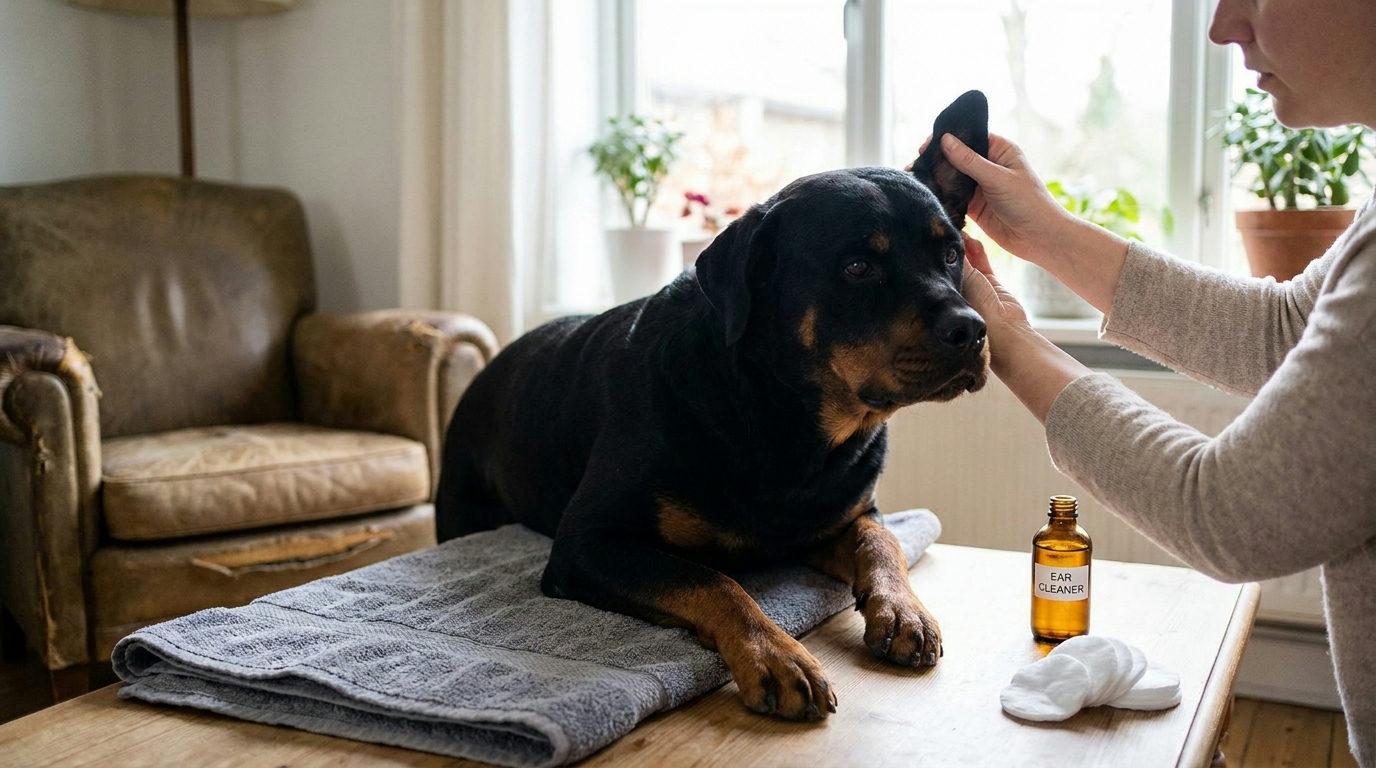
Only clean ears that look healthy. If you see any warning signs, skip cleaning and call your vet. When the ears look normal and your vet is happy for you to clean them, follow the cleaner’s label and the AKC page. A typical gentle routine looks like this:
- Settle your dog on a towel in a calm spot.
- Lift the ear flap gently.
- Apply the vet-recommended cleaner as its label directs.
- Gently massage the base of the ear if the label says to.
- Let your dog shake its head, holding the towel nearby.
- Wipe only the visible part of the ear with a cotton ball or gauze pad.
- Reward your dog and finish on a good note.
Never force anything into the ear. If your dog resists strongly, stop and ask your vet to show you how to do it.
How often should you clean?
This guide does not set a schedule. Some dogs need very little ear cleaning, while others need more. Ask your vet how often suits your dog’s ears, and write their answer in your notebook. Cleaning too often can be as unhelpful as never checking at all.
After swimming and bathing
Water can collect in the ear after a swim or bath. Ask your vet whether your dog would benefit from an ear-drying routine. If they recommend one, follow their instructions and note it on the fridge so everyone in the house does the same thing.
Make it part of a wider grooming routine
Ear checks fit naturally alongside brushing, nail checks and teeth checks. Pick one evening a week for a short grooming session that includes a look at each ear. Keep the order the same each time so your dog knows what to expect. Our essential Rottweiler grooming tips page has ideas for the rest of the routine.
A sample weekly grooming order
- A short brush of the coat
- A look at both ears
- A quick check of the paws and nails
- A lip lift to look at the teeth
- A treat and praise to finish
Questions to ask your vet (write their answers)
- Do my dog’s ears look healthy today?
- Which ear cleaner do you recommend for my dog?
- How often should I check and clean my dog’s ears?
- Should I dry my dog’s ears after swimming or bathing?
- Which signs should make me call you straight away?
- Can you show me how to clean my dog’s ears at this visit?
Asking your vet to demonstrate is one of the most useful things you can do. Watching once makes the routine much clearer than reading about it.
When to call the vet
Book a vet visit rather than cleaning at home if you notice redness, swelling, discharge, a strong smell, head shaking, a head tilt or pain. The VCA page explains why ear problems need a vet’s examination. Do not put human medicines or home remedies in your dog’s ears.
FAQ
Can I use cotton swabs?
The AKC page cautions against pushing anything deep into the ear. This guide does not suggest using swabs inside the canal.
Can I make my own ear cleaner?
This guide does not suggest home-made solutions. Ask your vet for a cleaner that suits your dog.
My dog hates having its ears touched. What should I do?
Go back to step one and take it slowly. If your dog still resists or seems sore, ask your vet to check the ears.
Is this veterinary advice?
No. It is a reading list plus a home checklist.
What not to do
- Do not clean ears that look red, sore or smelly. Call your vet instead.
- Do not push anything deep into the ear canal.
- Do not use home remedies or human medicines in your dog’s ears.
- Do not skip the AKC and VCA pages and rely on social clips.
Closing tip
This week, open the AKC and VCA pages, write five notes in their words, ask your vet which cleaner they recommend, and start with simple ear-touch practice. Rottweiler ear cleaning is easiest when it is calm, gentle and built into a regular grooming routine.